

 Shop
Shop
In the essay The Task of the Translator, Walter Benjamin writes of how there was a singular, “pure” language in the beginning, likened to a flower vase. When this vase broke, its shards became each of the languages we speak today. If this metaphor is considered in the context of translation, then two pieces inherently cannot be identical; they are instead meant to be complementary—matching at an edge, fitting together perfectly, but never the same.
The Jameel Library invites you to a week-long research lab developed and facilitated by Sarasija Subramanian. It will focus on unpacking translation as both tool and process, particularly on the fantasy of equivalence in translated material—assumptions based on the fact that nothing is lost (or gained, for that matter) during the process. Participants will engage with the possibilities of translation—more specifically the relationship between translation and accessibility—as a way to watch, listen to, and read material closely. The week will consist of collective reading, watching, and listening sessions of resources that address ideas of both translation and accessibility in an expanded sense, along with prompt-based exercises that help us think through language, the fallacy of equivalence, subjectivity, and the role that the “original” plays in our worlds.
The research lab will follow a part-seminar, part-practice, and part-programme based model, each with a focus on how translation can bring you both closer and further away from the point of origin. The idea is to try our hands at translating source documents into a language (or medium) other than the one it used to begin with, in an attempt to try and find what lies at the centre of this document (artwork, film, sound, text), what its intentions and meanings were, and how then can it be translated while keeping this core intact in some way.
If we were to translate a painting into an audio file, what would we focus on? What lies at the centre of the painting, or alternatively, what parts of it would we prioritise: Colours and textures? The story? The compositional elements? How does it make us respond, or how the artist hopes we would? What happens if we try to translate a work of our own into another medium—how do we find what lies at the centre of the work?
Duration of the lab: August 24-30, 2026
Apply here by July 20, 2026
Detailed agenda and syllabus will be shared with accepted applicants.
Participant Criteria
Age: 18+
Open to individuals in all fields of study and profession.
Participants must be present for all sessions of the lab. The series of readings, screening and programmes are planned in such a way that each builds on the one that came before. This makes it important for participants to go through each day together.
All sessions and material will be primarily in Arabic and English.
Application Requirements
Applications for The Task of the Translator research lab must include:
- A note that functions as an honest appraisal about the self, in the form of either a text or audio. This note need not list a single accomplishment or academic qualification. Note: If the response is written, then not more than 700 words. If the response is an audio, then the time limit is 5 minutes and it should be thought out, not too extemporaneous.
- A sample of your practice—perhaps an artwork, text, poem, website, or anything else, but only a single sample. Something that you think would help us understand what you are hoping for. Note: If it is a writing sample, then not more than 10 pages, if it is a research or curatorial project, then please explain it briefly.
- A written response (not exceeding 700 words) to the following prompts:
- Do you think about translation/accessibility in the work you make/do/think about?
- How would you define the task of the translator?
- What do you hope to get from this lab, and the time spent at Hayy Jameel?
Candidates are considered solely on the basis of their submitted documents and statement of intent, with a stress on why they are interested in this module, and how it relates to their practice and research. The selection process will be done by Sarasija Subramanian, along with representatives from the Jameel Library team.
The research lab is free of charge for all selected participants. Kindly note Hayy Jameel won’t cover any travel or accommodation costs.
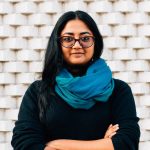
Photo by Daniel Wang
About Sarasija Subramanian
Sarasija Subramanian is an artist and editor based in Bangalore, India. Her preoccupations often stem from the desire to revisit critical moments of the past, bringing them back into the public eye to examine in our current contexts. Guided by an underlying editorial propensity, she often engages with documents and modes of thinking/organising that are indexical in nature; lists, instructions, systems of obedience and disobedience, rules, and actionable mandates (however outlandish), through gradual additions and subtractions, presenting finally an excerpted—or translated—form of the original.
She is also the editor of Reliable Copy, a publishing house and curatorial practice for works, projects, and writing by artists. Reliable Copy, founded in 2018, publishes books and documents, curates exhibitions and screenings, undertakes research projects, and hosts a wide variety of public programming.
