

 Shop
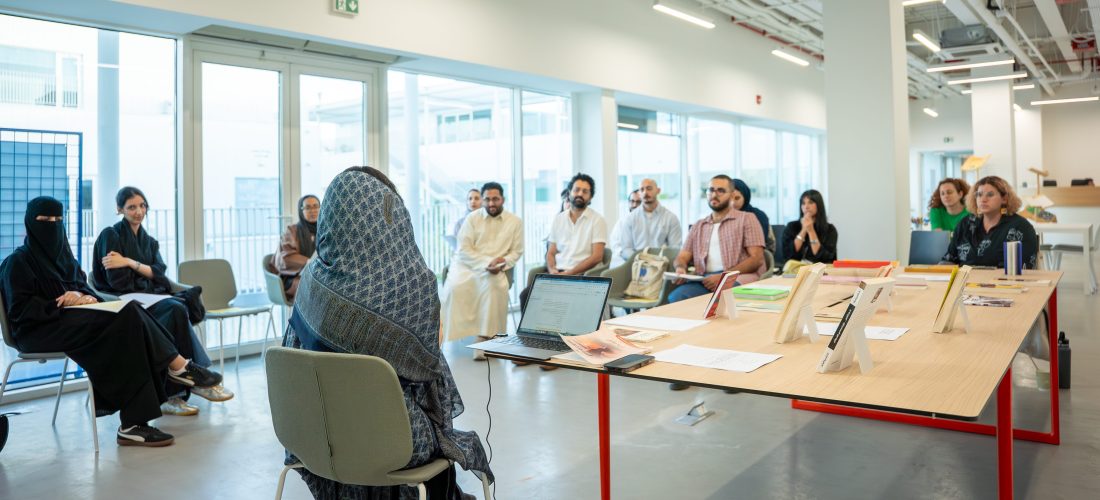
Join the Jameel Library for a wide range of programmes led by community members this November! You could also pitch your own programme here.
A Jameel Library Exhibition | At the Edge of Renewal with the Khaleeji Women’s Library and Archive
October 8, 2026 – April 10, 2027
The Jameel Library presents ‘At the Edge of Renewal’, a six-month exhibition developed by the Khaleeji Women’s Library & Archive (KWLA) and curated by Jood AlThukair, including work from Nouf AlHarthi, Hayfa AlGwaiz, Abeer Sultan, Dalal AlObaidi, Yasmeen Abdal, Fatima Al Jarman and Maitha Ali, among others.
‘At the Edge of Renewal’ is part of a series of exhibitions at the Jameel Library that invites book artists, librarians and publishers to reimagine the library through curated displays and reading lists. Each iteration becomes a library within the library, offering new ways to encounter collections, ideas and practices of reading.
Taking Ursula K. Le Guin’s 1981 essay “World-Making” as its point of entry, the exhibition begins with the idea of a world already here, already made, and the work of remaking it from within. On these terms, the exhibition assembles a record of how Khaleeji women have produced, published, and circulated their own work: books, periodicals, ephemera, oral histories, and independent and experimental publications. Much of this material has never been formally collected, and a substantial portion goes on public view here for the first time.
Working materials, including drafts, artists’ prototypes, dummy books, collages and projects-in-progress, are placed alongside finished works. Both are presented as primary documents, with attention given to the distance between them: the processes, decisions and possibilities that lie between a work in progress and its final form.
Reading Circle | “Where is Dujera?”– Reimagining Folktales with Roaa Sultan
Delivered in Arabic
November 7, 2026
4-7pm
Hejazi folktales form a living narrative heritage passed down through generations to transmit values and wisdom. In this interactive reading circle, participants gather at the gateway of storytelling to deconstruct oral folklore and reimagine its tales, heroes, and worlds using their own contemporary voices.
The circle opens with a critical reading of the Hejazi folktale Al-Dujera to explore its underlying dimensions. From there, participants transition into a practical workshop where each one of them reshapes a chosen folktale in their own unique way—whether by preserving its core moral or infusing it with a fresh meaning. The circle concludes with a collective storytelling session.
RSVP here.
About
Roaa Sultan is a researcher and writer operating at the intersection of narrative experimentation and cultural studies.
Grotto’s Fall Reading Series | The Unseen & the Unnamed: Speculative Realms in Arab & Global Literature
November 21, 2026
4-6pm
This Autumn, Grotto invites readers to cross into speculative literature, a season dedicated to “The Unseen & The Unnamed.” Together, we will examine how stories step beyond strict realism to explore how hidden forces, secret knowledge, and the power of language shape human identity, belief, and reality itself.
The second session, themed The Unnamed, will be dedicated to Earthsea: The First Four Books (1968-1990) by Ursula K. Le Guin.
Participants will transition into the archipelago of Earthsea (A Wizard of Earthsea (1968), The Tombs of Atuan (1970), The Farthest Shore (1972), and Tehanu (1990)), examining how Le Guin redefines magic through true names, the power of speech, and the necessity of naming and accepting one’s inner shadow.
RSVP here.
About
Grotto is a Jeddah-born cultural initiative dedicated to uncovering the literary and historical undercurrents of the Hijaz through creative programming and research-driven community projects. It aims to bridge old world heritage with contemporary thought.
Book of the Month
Al-Hirafiyyoun fi Madinat Jeddah (Craftsmen in Jeddah) by Wahib Kabli
We chose Al-Hirafiyyoun fi Madinat Jeddah (1996) by engineer Wahib Kabli for its documentation of the crafts and manual trades of Jeddah city during the fourteenth Hijri century, and of the social and economic life that moved around them. The book traces how craftspeople were organised, from the shaykh of the guild to the master and the apprentice, and includes rare historical photographs and paintings by a number of visual artists. It reminds us that Jeddah was built by hands that had names, standing, and order.
